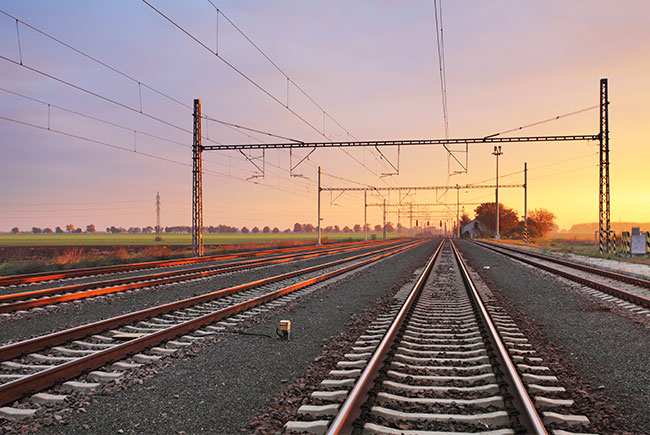
The Turin–Lyon line is a new railway line for freight and passengers stretching 270 km, 70% of which is in France and 30% in Italy. It is the central section of the Mediterranean Corridor, one of the nine axes of the European TEN-T transport network, which stretches for 3,000 km, linking seven EU corridors from east to west.
The cross-border section, built by the bi-national project promoter TELT, connects the 65 km between the two international stations to be constructed at Saint-Jean-de-Maurienne and Susa/Bussoleno, where the tracks will then link up with the existing lines. The main project is the Moncenisio Base Tunnel, the longest railway tunnel ever built. The tunnel, which consists of two tubes with a single track, is 57.5 km long, 45 km of which are on French territory and 12.5 km on Italian territory.
The work currently underway involves the excavation of a total of 162 km of tunnels, a complex project comprising two parallel tunnels, four access shafts and 204 safety bypasses. 113 km of geognostic surveys and core sampling have already been carried out in Italy and France over the years.
A more efficient, environmentally friendly and cost-effective infrastructure
The new project will take over 1 million lorries off the roads every year and help the Alps breathe easier by reducing annual CO2 emissions by 1 million tonnes.
150 years after the opening of the Fréjus railway tunnel (at an altitude of 1,300 metres), which is home to the existing line, the new tunnel will transform the existing mountain route into a lowland railway, making rail transport more competitive.
Indeed, trains travelling on flat terrain allow for energy savings and higher speeds. On the Italian-French section, the existing line currently fails to meet international transport standards: it climbs the mountain with a gradient of up to 3%, meaning that trains require up to three locomotives, resulting in a 40% increase in energy costs. The old Fréjus tunnel, opened in 1871, has a diameter smaller than current international standards and consists of a single tube, which does not meet current safety standards.
More efficient, ecological and economic infrastructure
The new project shall take more than 1 million lorries per year off the roads and result in the Alpine region breathing better thanks to the reduction of 1 million tonnes of CO₂ annually.
150 years after the inauguration of the Frejus railway tunnel (at 1,300 metres in altitude), through which the current historic line passes, the new tunnel transforms the existing mountain line into a lowland railway, making rail transport more competitive.
Having the train travel on level ground enables energy savings and higher speeds. Along the French-Italian section, the historic line does not currently meet international transport standards. The line actually climbs up the mountain with a gradient of up to 3%, meaning trains need as many as three locomotives, requiring as much as 40% more energy. The old Frejus tunnel, opened in 1871, has a smaller diameter than today’s international standards and has a single tube, which is also not up to current safety standards.