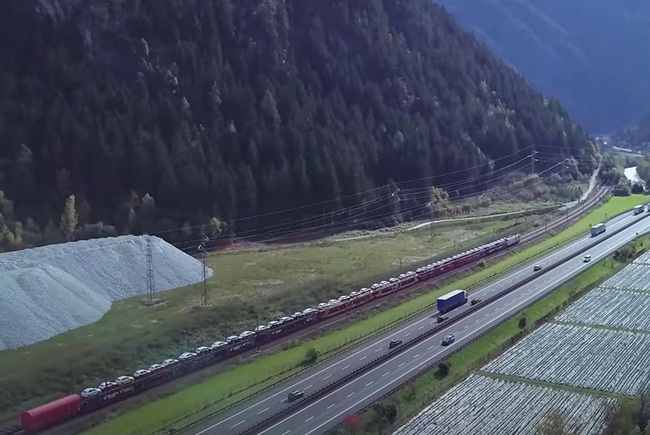
The project involves the four-track expansion of the railway line between Verona and Fortezza, which forms part of the “Scandinavian–Mediterranean” corridor of the TEN-T network. The expansion is divided into lots, including the bypasses around Trento, Bolzano and Rovereto, the four-track expansion of the Fortezza–Ponte Gardena section and the approach to the Verona junction, to which the Brenner Base Tunnel (BBT-SE) is added, which will form a new border crossing point.
The entire project (comprising the BBT and the Verona–Brenner four-track extension) is an infrastructure initiative designed to improve the quantity and quality of rail services in order to meet future transport demand, in particular by increasing freight capacity.
The project has received partial public funding.
“With effect from 12 March 2026, the date on which Decree-Law No. 36 (published in the Official Gazette No. 58 of 11 March 2026) came into force, in accordance with Article 5 of that decree, the Chief Executive Officer of RFI SpA has taken over from the previously appointed Extraordinary Commissioners.”
The Extraordinary Commissioner, by Order 3 of 15 June 2026, appointed Giuseppe Romeo, Head of the North-East Area Investments Department of RFI S.p.A.
The objectives
Construction is currently underway on the new railway line crossing the Brenner Pass, i.e. the Brenner Base Tunnel (BBT) – managed by the European company “Brenner Base Tunnel – Brennero Basistunnel” – to which the southern access line, Verona–Fortezza, will be connected. This line will be built by RFI.
These technological and infrastructure improvements will enable an increase in freight capacity, amounting to an additional 60–90 trains per day. The reduction in gradient restrictions will facilitate the use of longer and heavier trains, resulting in an increase in load capacity of around 20% per train. In addition to commercial speed, the standards for service regularity and punctuality will be raised.
Expected benefits
The full-scale project will reduce the maximum gradient to 12.5‰ (from the current 23‰). Once completed, the works will increase the overall capacity of the corridor (part of the Scandinavian-Mediterranean TEN-T). The key objectives are to increase the line’s transport capacity and performance levels (estimated at an additional 60–90 freight trains per day), improve the reliability and punctuality of the rail service, and completely separate freight traffic from local public transport passenger services. In fact, once all the works will be completed, it will be possible to reroute long-distance services via certain sections to significantly reduce journey times, whilst maintaining services to the main towns and ensuring a more efficient, faster and more frequent local public transport service along the existing line.
The long-term aim is to reduce journey times along the Innsbruck–Bolzano route by around 50 minutes. Furthermore, from a freight perspective, the drastic reduction in the maximum gradient to 12.5‰ on the Fortezza–Verona line will allow for longer trains and, on average, heavier loads (+20% per train), thereby improving the efficiency of freight transport.
In addition, technological upgrades are currently underway on the existing line, aimed at improving the reliability, punctuality and quality of rail services through the installation of more advanced technologies, whilst also complying with EU requirements for the TEN-T network.